Pages

Showing posts with label internet. Show all posts

Monday, December 26, 2011

Goddady Tries To Recover After SOPA PR Nightmare

If you are living in the United States, you should have heard about SOPA (Stop Online Piracy Act) and Protect-IP, which, when passed, would give companies rights that they should not have. If it passes, IP rightsholders (a term vaguely defined) could send notices to payment processors or ad services like Google Adsense to force them to stop doing business with listed websites, all without legal process.

Site owners have five days to file a counter-notice, but neither payment processors or ad networks have any obligation to respect it. Even worse, they are granted “immunity for choking off a site if they have a “reasonable belief” that some portion of the site enables infringement”.

I suggest you check out the Electronic Frontier Foundation, this post by Mythbuster Adam Savage and this nice infographic for additional information about SOPA.

The Internet can be a mighty weapon; the latest company to find out about this is GoDaddy, who support SOPA and Protect-IP.

A Reddit user suggested to move away domain names and hosting from GoDaddy to other providers to boycott the company for their pro SOPA stance. This got the ball rolling with regular users and companies moving domains away from GoDaddy at a rapid pace. It is not clear how many webmasters and companies have moved domain names and hosting from GoDaddy to other companies, but it is likely that the value is in the tens of thousands already.

Other hosting companies sized the opportunity with special offers for GoDaddy customers who move their domains and hosting (see blog posts on Name, Hostgator or Easy DNS for example.

Godaddy released a press release a day later, stating that the company “is no longer supported SOPA”, and that “Go Daddy will support it [again] when and if the Internet community supports it”.

And while it is nice to see that GoDaddy has changed their stance on SOPA, you’d still want to ask yourself if you want to continue working with a company who supported the bill in the first place.

You may also be interested in a list of companies and organizations who openly support SOPA. You find the list here.


© Martin Brinkmann for gHacks Technology News | Latest Tech News, Software And Tutorials, 2011. | Permalink |
Add to del.icio.us, digg, facebook, reddit, twitter
Post tags: ,


Friday, December 16, 2011

The technology that still has to improve in 2012

If you look around at what technology has brought us in 2011 it’s been a truly momentous year.  The iPad 2, new exciting Android tablets with the proper tablet version of the OS, Windows 8, the HP TouchPad with WebOS, Windows Phone ‘Mango’, Ultrabooks, cameras with GPS, multi-touch in laptops, new super-efficient Intel and AMD processors and more.  These have all either been announced or released this year.  In short technology is moving ahead at a pace faster than ever before and amazingly the prices do seem to be tumbling.

This is all great news but there are still some technologies that have got to change in 2012 and they need to do this very quickly or else the technology we use will move so far ahead of them that innovation itself will begin to suffer.  Those technologies are all concerned with the Internet itself or with Internet communications.

Let’s start with the ADSL or DSL broadband lines coming into our homes and offices.  Unless you’re lucky enough to live in a country such as Sweden which already enjoys 50Mb/sec lines or faster you’ll be lucky to get a stable connection on a tenth of that.  Indeed the old 2 miles from the telephone exchange line is wearing thin with many but telecoms companies and governments simply aren’t doing enough to rectify the problem.  Here in the UK we think that people who live in countryside villages and who still have to use dial up or get a 512k/sec broadband line have a bad deal.  In some countries where the distances are far further such as the USA, Canada and Australia the problems are 100 times worse.

It’s a similar story with mobile networks.  The USA was late to the 3G game but has forged ahead with 4G connections.  Many other countries however are still several years away from moving to 4G, but which time it’ll be time to move onto something else in all probability.  The mobile networks also need to sort out the mess that is unlimited data plans and manage their networks in such a way as to allow people to use mobile broadband properly.  The pricing for mobile broadband also has to drop by at least 50% next year.  There’s already more than enough money to be made and many people, especially those in isolated areas would love to move away from an ADSL line and onto a SIM contract.  At the moment though it’s still far too expensive to do this.

Many people think that a universal wireless solution like a full roll-out of 4G or WiMax will solve the problem and make traditional broadband lines obsolete.  Telecommunications companies need to protect their bottom lines however and, as such, a lot of innovation is being stifled for reasons of profit and share prices.

When we actually are able to get online though using our sexy new devices we find that the web is still looking as old and outdated as it was in 2003.  Back then we didn’t have the preponderance of smartphones, tablets and touch-screen PCs that we do now.  Even next year’s iMacs are rumoured to be multi-touch but almost none of the world’s largest websites have moved to a touch-friendly design yet.  I did this with my own website last month and firmly believe it’s absolutely essential.  Some companies are making a move in this direction with the BBC launching a part-touch-friendly website recently but the new YouTube redesign is traditional menus and mouse control only.

It’s one thing having new interfaces and new form factors that enable us to use the web in new and exciting ways, and new operating systems that are designed primarily around touch.  If we can’t get good, quick and stable connections to the web though, or properly and effectively use the websites we visit when we get there all this technology is going to waste.  Here’s hoping that 2012 brings us much more than just a move to IPv6 and some 4G radio spectrum auctions.  What technologies do you think really need to change in 2012 and do you agree with me here?  Why not tell us in the comments.


© Mike Halsey (MVP) for gHacks Technology News | Latest Tech News, Software And Tutorials, 2011. | Permalink |
Add to del.icio.us, digg, facebook, reddit, twitter
Post tags: , , ,


Thursday, November 10, 2011

When will the Have-Not’s Get PCs and Internet at Home?

It’s been announced that US government is about to expand its scheme to get broadband and PCs into low-income households across America.  It’s a similar scheme to others that have been run and that continue worldwide.  As part of the deal Microsoft will provide $250 laptops and desktops pre-loaded with Office and Redemtech will offer refurbished PCs for $150.

This still doesn’t hit the magic price point of $99.  This is the point at which something drops to the magic ‘obtainable’ price and hearts and minds are won.

Part of the problem stems from the fact that technology is still relatively expensive to manufacture.  There are also only so many manufacturing plants worldwide and the current demand for high-tech electronics such as Apple’s iPad and smartphones dominates many of them.

You might think then that mass-producing these devices would inevitably drive manufacturing costs down.  It’s not quite that simple though as it also emerged today that the new $79 kindle actually costs $84 to make, with Amazon set to make the extra money back through books store sales.

The mark-up on the price of the iPad also isn’t great when you factor in the distribution and retailer costs.  The raw components for technology are, in some cases, becoming harder to mine and some costs are going up, not down.

You might think then that what we really need is a push back to slightly older, some might say “tried and tested” technology that genuinely is cheap as chips to manufacture to help push it into the homes of low-income households worldwide.  But issues around supply and manufacture will always make this technology just as expensive to produce as a new invention as they are all made from the same raw components.

The problem is though that millions of children worldwide are missing out of the educational benefits that computers and the Internet bring.  Pensioners around the world are continuing to be isolated because of the lack of Internet communications and don’t have access to online shopping services that can help them.

The US government said today that last year the number of Americans with broadband at home rose to 68%.  I don’t know what you think but when compared to some scandanavian and far-eastern countries this is pretty pathetic.  It’s a number shared by too many developed countries however and in the developing world we’re often looking at single digit percentages.

What’s need is a greater effort and a greater subsidy to help low-income households around the world get a computer of some description and a broadband connection at home, and to make sure that every child has easy access to both.  In a time when the budgets of world governments are being stretched, and household budgets are being stretched further, the gap between the have’s and the have not’s is widening faster than ever before.

In a report by USA Today, FCC Chairman Julius Genachowski said “In this difficult economy, we need everyone to be working together on solutions, Broadband is a key to economic and educational opportunity and these kinds of commitments to close the digital divide are powerful.”

Never was a truer word said.  Now let’s see if world governments are prepared to do anything about it.


© Mike Halsey (MVP) for gHacks Technology News | Latest Tech News, Software And Tutorials, 2011. | Permalink |
Add to del.icio.us, digg, facebook, reddit, twitter
Post tags: , , , ,


Tuesday, November 1, 2011

Opera Reader Could Revolutionize The Way We Read On The Internet

One of the biggest usability issues on today’s Internet are scrolling web pages. Browsers automatically add scrollbars to web pages if the contents exceed the vertical or horizontal display limitations of the window or computer screen. This scrolling breaks the readability of a web page significantly. Users who scroll need to locate the text position where they stopped reading afterwards. Most Internet users use headlines, paragraphs or other visible elements on a page as markers for that.

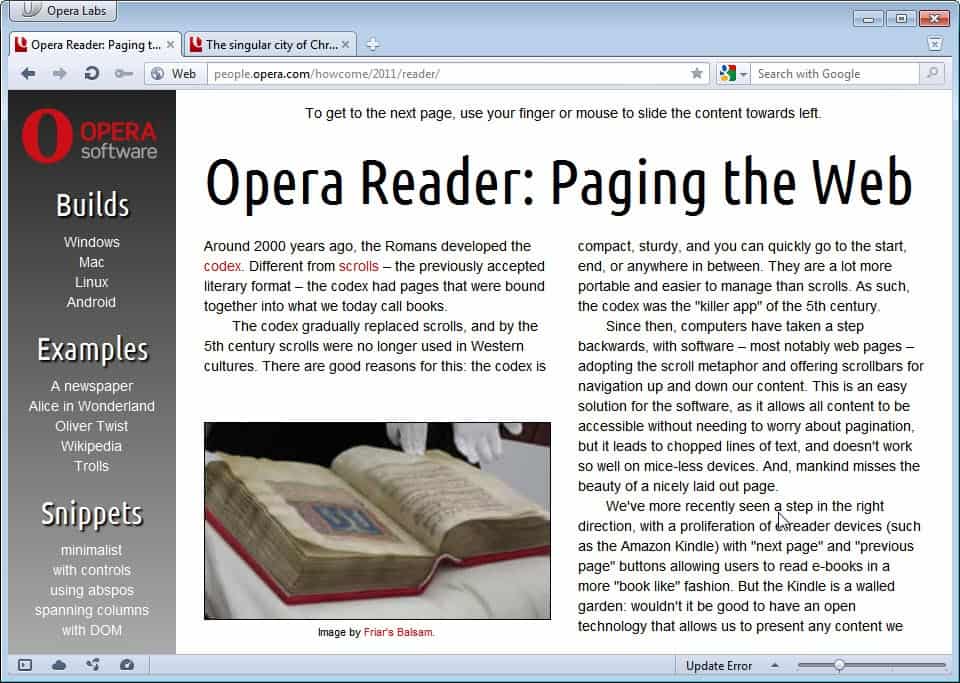
Opera Reader is an experimental Opera version that does away with all the scrolling on the Internet. It’s premise is to display all contents of a website directly on the screen. It basically breaks down a website into pages that are displayed just like the pages of a book. The developers have used a scroll and book comparison to highlight the differences. Scrolls are like standard websites that go on and on until the content ends, while books use pages that offer several advantages over scrolls.

Opera Reader turns scrolls (aka scrolling web pages) into books (aka paged web pages). Whenever you open a compatible web page in Opera Reader, you will notice that all of its contents are displayed on the screen without horizontal or vertical scrollbars. Here is how a compatible page looks in the standard Opera browser and in Opera Reader.

opera browser

opera reader

The core difference is the missing scrollbar. Opera Reader users can use the mouse to flip pages. Alternatives including using the keyboard (left and right) or gestures on touch enabled devices.

Separating a website into pages does not reduce the browser’s functionality at all. It is still possible to search, print or work with the whole web page like it would be in a standard version of Opera.

The Opera team has published a few examples on the Opera Reader website. This includes a basic newspaper, the novels Oliver Twist and Alice in Wonderland and a sample Wikipedia page.

opera reader example

The biggest issue with Opera Reader in its current form is that websites need to add specific CSS3 code to support the feature. Opera needs to come up with a way to automate the processing of web pages in Opera Reader. If the company manages to do that, it could change the way we read contents on the web forever.

Opera Reader is currently available as a preview version for Windows, Mac, Linux and Android devices. Interested users can download the preview release from the official project website over at Opera. (via)


© Martin Brinkmann for gHacks Technology News | Latest Tech News, Software And Tutorials, 2011. | Permalink |
Add to del.icio.us, digg, facebook, reddit, twitter
Post tags: , , ,