Pages

Showing posts with label trojan. Show all posts

Friday, November 11, 2011

Windows XP Has 10-Times The Infection Rate Of Windows 7

The Security Intelligence Report is a biannual report by Microsoft that analyzes past and present security trends. It focuses on “software vulnerabilities, software vulnerability exploits, malicious and potentially unwanted software, and security breaches”. The latest report published yesterday focuses on the first and second quarter of 2011 and compares the findings with data from previous years.

How does malware propagate? According to Microsoft’s report (gathered from Microsoft’s Security Removal Tool) almost 45% requires user interaction, e.g. executing a file. Another 43% uses AutoRun capabilities via USB or a network to infect a system. The remaining 12% list file infections, exploits where updates are available and password brute force attacks.
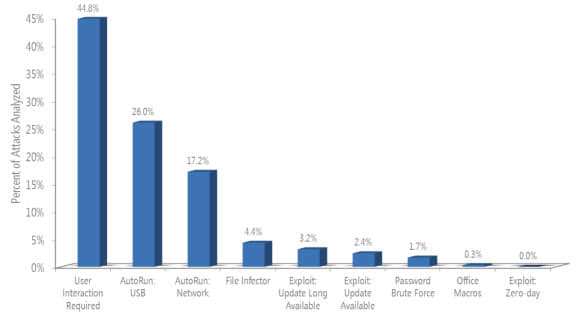
malware propagation

It is interesting to note that disabling autorun would eliminate nearly 50% of all malware threats. Exploits, which get lots of coverage on the Internet attribute to only 6% of detections.

A look at the different types of exploits reveal that exploits targeting Java were responsible for up to one-half of all exploits in a given quarter. Operating system exploits have passed HTML and Script exploits in the second quarter which can be solely attributed to a vulnerability i Windows Shell which was for instance exploited by the Stuxnet family.

When it comes to document exploits it is Adobe Reader and Acrobat who have accounted for most of the exploits in the first half of 2011.

Operating system infection rates paint an interesting picture. Nearly ten times as many Windows XP SP3 systems get infected as Windows 7 SP1 64-bit systems. Windows 7 Service Pack 1 32-bit systems have a ratio of 1:6 compared to Windows XP’s infection rate.
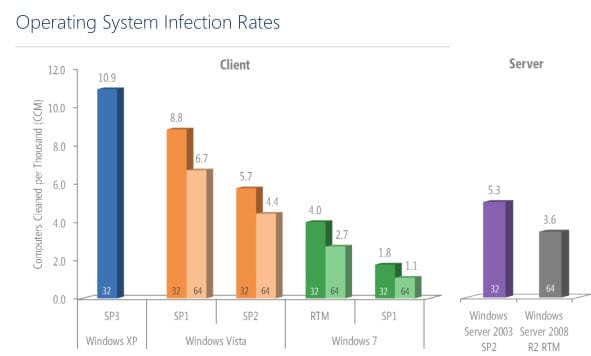
operating system infection rates

Even Windows Vista with its latest service pack installed reports only half of the infection rate that Windows XP reports.

A look at the different threat families and categories sees Adware at the top followed by misc potentially unwated software, misc trojans and a second smaller group lead by Worms, Trojan downloaders, virus, password stealers and backdoors.
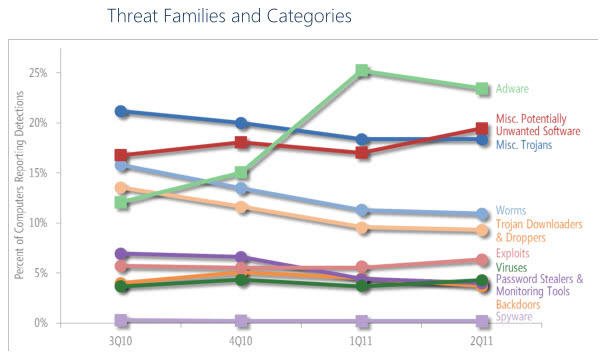
threat families

Email spam decreased dramatically in the past twelve months according to the Microsoft report. From 89 billion messages in July 2010 to 25 billion in June 2010. Microsoft attributes this to the takedown of two major botnets in August 2010 and March 2011.

Global Infection Rates by country

  • United States:
  • Brazil: Most trojan downloaders and droppers, most exploits, most password stealers and monitoring tools.
  • France: Most Adware
  • United Kingdom
  • China: Most backdoors and spyware
  • Germany
  • Russia: Most misc potentially unwanted software
  • Italy
  • Canada
  • Turkey: Most misc trojans, Worms and Viruses
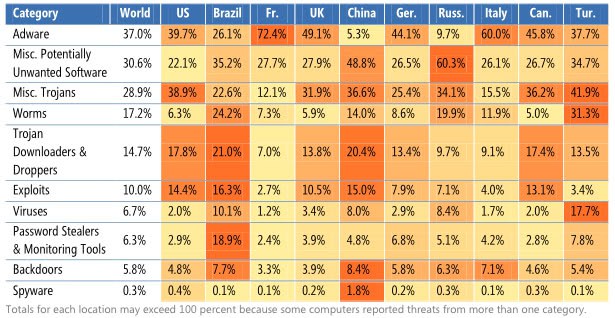
global threats

Interested users can download the latest report and previous reports from Microsoft’s Security Intelligence Report website.


© Martin Brinkmann for gHacks Technology News | Latest Tech News, Software And Tutorials, 2011. | Permalink |
Add to del.icio.us, digg, facebook, reddit, twitter
Post tags: , , , ,


Wednesday, November 2, 2011

Duqu Zero-Day Exploit Discovered, Removal Tool Released

If you have been following security news lately you may have already heard about the Duqu rootkit that combines the technology of the Stuxnet rootkit with a backdoor trojan and keylogger. Duqu has been discovered on October 18 and infection reports have started to come in soon thereafter.
Not all security suites and products detect the Duqu rootkit right now which, in combination with the fact that it exploits a zero-day vulnerability in Windows, makes it a very dangerous threat. Microsoft is currently working on a patch to protect systems from the vulnerability (which would make further infections on patched PCs impossible)

Rootkit.Duqu.A is digitally signed (with a stolen and revoked certificate) which means that it targets not only 32-bit Windows systems but also 64-bit editions of the Microsoft Windows operating system. According to information posted by Bitdefender, Duqu runs for 36 days on a computer collecting information entered via the keyboard. This may include passwords, emails, conversations, logins on popular sites and even banking and credit card information.

Symantec has posted additional information about Duqu’s installer. According to Symantec’s information, Duqu is spread as a Microsoft Word document that exploits a Windows kernel vulnerability that allows code execution. When a user opens the Word document the malicious code is executed and Duqu is installed on the system.

Duqu infections have already been confirmed in countries such as France, Switzerland, India, the United Kingdom, Austria and the Netherlands.

Symantec has released a whitepaper in pdf format that contains all known details up to this point.

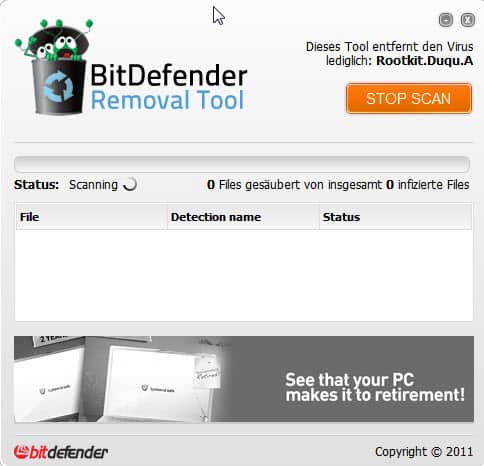
Windows users who want to make sure that their system is clean and not infected by the Duqu rootkit can use Bitdefender’s Removal Tool to scan the system and if necessary disinfect it.

duqu rootkit removal

The portable rootkit remover can be downloaded from an official Bitdefender website. All that Windows users need to do is to click on the Scan button to start the scan. The program will list any files that have been identified to be part of the Duqu rootkit. Please note that the program may require elevated rights on some machines.

Is there a way to protect your computer in the meantime? Yes, do not open Word documents locally. Use an online document viewer like Google Docs or Docs.com for that. (via)


© Martin Brinkmann for gHacks Technology News | Latest Tech News, Software And Tutorials, 2011. | Permalink |
Add to del.icio.us, digg, facebook, reddit, twitter
Post tags: , , , ,


Wednesday, October 19, 2011

German Federal Trojan Supports 64-bit Windows Systems, Analysis Suggests

About two weeks ago word got out that the Chaos Computer Club got their hands on what they identified as a German state-sponsored trojan. The initial analysis assumed that the trojan would only run on 32-bit Windows systems. We reviewed a software that would detect the trojan on the system.

Two weeks later things have changed considerable. Several German states acknowledged that the backdoor was used by German police forces to spy on communication software installed on computers. According to the news spyware programs were in use since 2009.

The initial analysis of the contents was far from complete. Security experts at F-Secure and Kaspersky posted the results of their analysis recently which offer a more detailed view of the malware’s capabilities.

Kaspersky discovered that the trojan installer supports both 32-bit and 64-bit Windows operating systems. Experts previously assumed that only 32-bit systems could be targeted by it.

The second finding is a list of applications that the trojan has been designed to monitor. This list is larger than the initial list that the Chaos Computer Club published. A total of 15 applications are listed, including Firefox, Explorer, Opera, Skype, Microsoft Messenger, ICQ and Yahoo Messenger.

The trojan injects code into those processes:

Code injection into target processes is carried out by the dropper, two user-mode components and also a 32 bit kernel driver with extended functionality compared to the version previously analyzed, which only provided an interface for registry and file system modifications. This new driver starts an additional thread that constantly loops over the current list of running processes and injects a DLL into each whose image name matches an entry from the following list:

The 64-bit Kernel driver is limited in its functionality compared to the 32-bit component.

Contrary to the 32 bit version, the 64 bit driver does not contain any process infection functionality but only provides a rudimentary privilege escalation interface through file system and registry access. Similar to its brother, it creates a device and implements a basic protocol for communicating with user-mode applications.

Kaspersky identified the a 1024 bit RSA certificate issued by Goose Cert on April 11, 2010.

The F-Secure blog has more information on how the backdoor was installed on target systems.

In one case, the trojan was installed on a suspect’s laptop while he was passing through customs & immigration at the Munich International airport.

The existence of a 64-bit component, the monitoring of additional processes and information on how the trojan was installed on systems confirms that there has been more to that state sponsored trojan than initially assumed. The majority of security software available should detect the backdoor by now.


© Martin Brinkmann for gHacks Technology News | Latest Tech News, Software And Tutorials, 2011. | Permalink |
Add to del.icio.us, digg, facebook, reddit, twitter
Post tags: , , , ,


Monday, October 10, 2011

Detect Alleged German State-Sponsored Trojan On Your PC

I have monitored news about the alleged German state-sponsored trojan closely ever since the German Chaos Computer Club posted information about it online. While there is not a definitive proof that it is indeed malware designed and operated by German police forces, it is definitely something that computer users need to be aware of.

I do not want to get into to many details at this point in time and suggest you read the long post over at the club’s website to get a better understanding of what it can and cannot do. A binary version of the program has been uploaded to the club’s website as well.

Only that much. The so called Bundestrojaner (federal trojan) works in its detected form on 32-bit Windows operating systems. The trojan targets software used for communication. This includes Skype, ICQ or the MSN Messenger but also web browsers. It acts as a keylogger and contains functionality to download and execute code from remote locations. It can furthermore take screenshots, record audio and supports remote updating.

The core issue here is not that such a trojan exists as it was openly discussed in Germany, but that the trojan is capable of going beyond what the German Federal Constitutional Court allowed police forces to do with it.

While it appears to be more of a local German issue, it is not completely out of the question that the trojan was planted on computer systems of foreign nationals.

Security company Steganos has released a first version of the – German only – Anti-Bundestrojaner, a software to detect the trojan on 32-bit Windows systems. The software is free and portable, and can be downloaded from the Steganos website with a click on the Jetzt Herunterladen button.

All that you need to do is to run the program and click on the Analyse starten… button in the interface. This starts the system scan.

steganos anti bundestrojaner

The security software scans the system and will display findings in the interface. It will scan the system for drivers and libraries, and try to make a connection to the remote servers of the trojan. A red icon in front of a line followed by the word Kritisch (critical) means that it has detected a file belonging to the trojan.

If that is the case a popup will be displayed prompting the user to either selected Ja (yes) to delete the identified files or Nein (no) to leave them on the system.

If you select yes you are asked to reboot the system after the deletion completes. Select ja to reboot right away or nein to reboot at a later time.


© Martin Brinkmann for gHacks Technology News | Latest Tech News, Software And Tutorials, 2011. | Permalink |
Add to del.icio.us, digg, facebook, reddit, twitter
Post tags: , , , ,