It would appear that Google’s unfortunately lax approach to vetting apps submitted to the Android store is counting heavily against the platform, as McAfee have released figures showing it is now becoming the biggest target for malware writers.
Nokia’s now mostly retired Symbian operating system still sits in a resounding first place with just under three quarters of all malware, but Android now has a malware problem that is growing exponentially according to the security company’s quarterly threats report…
Last quarter the Android mobile operating system (OS) became the most “popular” platform for new malware. This quarter Android became the exclusive platform for all new mobile malware. The Symbian OS (for Nokia handsets) remains the platform with the all-time greatest number of malware, but Android is clearly today’s target.
They say that SMS-sending trojans are still the biggest threat but that trojans that record phone calls to steal sensitive information are now beginning to appear.
While Google’s problems with malware on their Android platform are well known it should be pointed out that this report makes no mention at all of either Apple’s iOS, Microsoft’s Windows Phone or RIM’s Blackberry apps security. It is odd that the chart they provide doesn’t single out these operating systems at all, merely referring to “Others” at around 10% of the malware problem.
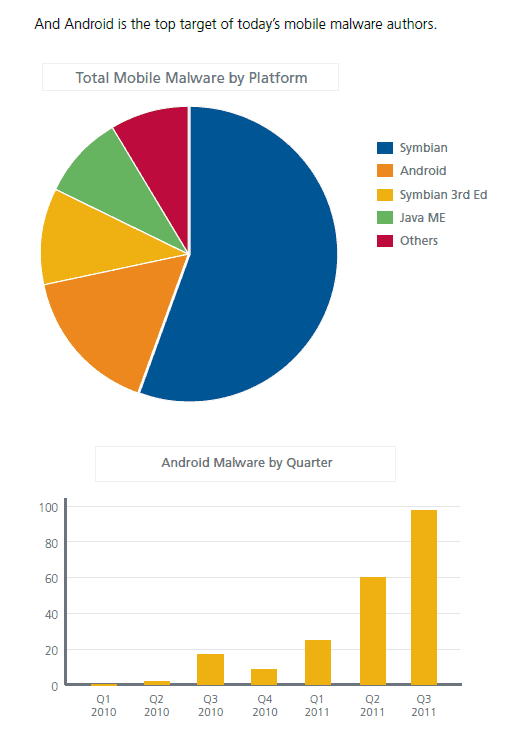
Ten percent of all smartphone malware however is still a huge issue and assuming that 10 percent is split equally three ways (which is just an assumption to highlight a point), while it would only be about 16% of the total malware available for Android, we’re still talking about huge numbers indeed.
Mobile malware is a continuing problem and one I highlight as often as I can. The reason for this being that this malware can cost you real money in premium rate texts or other mobile charges that can’t occur on your PC. It’s entirely within the gift of your mobile operator as to whether they will refund such costs, but as the mobile malware problem escalates it will become more and more likely that operators will simply blame the user for downloading and installing the malware (which is fair to be honest) and refuse to issue any credits.
As the introduction to the report the company says…
The third quarter of 2011 offered its fair share of noise and signal: Malware continues to be produced daily at high levels, but we often miss its sophistication—which lies buried beneath the big numbers. McAfee Labs saw some significant increases this quarter in stealth malware techniques, often referred to as rootkits, especially from the TDSS family. We also observed the continued emphasis on mobile malware, specifically targeting the Android operating system. In fact, this quarter Android was the sole target of mobile malware writers. A true portent indeed!
Unfortunately the mobile malware problem generally is receiving precious little widespread publicity. While IT Enthusiasts might be increasingly aware of the need to install an anti-virus package on their handsets, the bulk of consumers will still see the their smartphones as embedded OS devices that will just work in the way their TV or toaster does. They won’t necessarily see it as a device that can be infected and compromised.
While the report is clearly intended to shock, without the exact figures for iOS, Windows Phone and Blackberry’s being released it is hard to guage overall how bad the problem is and to make a judgement over how much more of a target Android is over the next platform.
© Mike Halsey (MVP) for gHacks Technology News | Latest Tech News, Software And Tutorials, 2011. | Permalink |
Add to del.icio.us, digg, facebook, reddit, twitter
Post tags: android, malware, mcafee, report


