Pages

Showing posts with label Twitter. Show all posts

Tuesday, February 14, 2012

Twitter Makes HTTPS Default For Signed In Users

Twitter users had an option to turn on https for their connections to the popular social messaging site for quite a while. Users who turned the feature on, benefited from encrypted communication with Twitter which blocked snooping and eavesdropping attacks, and recommended when for connections to the site on public (wireless) networks. This was especially useful for Twitter users on the go, but recommended for all users as it should not have any visible negative effects.

Twitter yesterday announced that they enabled HTTPS for all of their signed in users by default. Nothing changes for users who have enabled HTTPS previously in the site preferences. Everyone else will now notice that Twitter will automatically load https://twitter.com/ whenever they visit the website. Users who enter http://twitter.com/ are automatically redirected to the https version of the site.

https twitter com

While all users are now moved to secure https connections, some may experience connectivity issues because of this. Those users can disable the new feature in the settings.

Always use HTTPS is a preference under Account there. You may need to scroll down until you see it on the page. Just remove the checkmark and click on save changes afterwards to disable forced https connections on Twitter. You need to enter your Twitter password for confirmation to save the settings to your account.

twitter https only

Once disabled, you won’t be redirected anymore to https if you want to load the http version of the site. You basically get the choice to load http://twitter.com/ or https://twitter.com/

Twitter is not the first company that moves all of their users to https. We have seen similar moves by companies such as Google or Facebook as well.

You can read the original announcement at the official Twitter blog. (via Techdows)


Tuesday, January 31, 2012

ShowMeTrend Links Twitter Tags To Web News

The messaging platform Twitter can be used for trending purposes. The more users talk tweet about a certain topic, the more popular it has to be. While it is not possible to say that with absolute certainty, as other factors like automation play a role as well, it can often act as an indicator. Twitter displays the top ten trending topics for a single country, with options to change the country to another one on the page.

While it is possible to read the messages on Twitter about a trending topic, it is not guaranteed that you will see any links in the messages that you are reading.

That’s where the web service ShowMeTrend comes into play. The service links the top 10 Twitter trends of a particular day to Google News articles about that particular topic.

twitter trends

The trending topics get updated regularly, and it appears as if the links from Google News are pulled more or less whenever they appear there. All news articles are linking directly to the site they have been published on. It is furthermore possible to open Google News’ listing of all related news, or to go back and forward one news entry on the ShowMeTrend website.

Selections can be made at the top to switch from the day’s worldwide trends to country specific and date/time specific trends. About ten countries can be selected, from Germany and the United States to the Netherlands, UK or Brazil. The service’s back catalog of Twitter trends begins in October 2011, which is an indicator that it is a relatively new service. Users can not only select the date but also the time of a day to get a listing of trending topics.

One of the issues that the developers need to fix is the lack of links for some topics. Some trends show a white listing and not a single news item. One of the options here would be to either improve the search algorithm or to use additional news sources besides Google News.

ShowMeTrend is an interesting service for researchers, marketing agencies and individual users. Have you tried the service? If so, what is your take on it?


Friday, January 27, 2012

FBI Seeks Disasters Social App and Twitter Announces Censorship

The FBI is looking to develop an emergencies early warning system that works by “scraping” information in real time from social networks.  The US policing and intelligence bureau has asked contractors to suggest possible solutions and to come up with ways in which this might work.  In a post on the Federal Business Opportunities website called “Social Media Application” they say…

The Federal Bureau of Investigations is conducting market research to determine the capabilities of the IT industry to provide a social media application. The tool at a minimum should be able to meet the operational and analytical needs described in the attachment.

This is actually harder than it might appear.  On the face of it such a program would scour Twitter, Facebook and other websites for key words.  However disasters can never be predicted and, as such, determining the language people will use at the time is extremely difficult.  Even harder would be to determine where an event is taking place.

In theory such a program would also be able to highlight major crimes when people mention them online.  People have until February 7th to submit their ideas to the bureau.

In other Twitter news the company behind the hugely successful micro-blogging site has today announced that they have developed a way to selectively censor tweets on a country by country basis.  In it’s blog they said they could now “reactively withhold content from users in a specific country”.

It is curious as to why Twitter, a company that has always encouraged free speech, would make such a move.  Social networks were used extensively in the uprisings in Egypt and the middle-east last spring, and were widely hailed for helping protestors galvanise such huge crowds of support.

Having the ability to censor specific types of tweet in individual countries could potentially prevent this type of thing from ever occurring again.

As justification the company said “that have different ideas about the contours of freedom of expression” going on to cite France and Germany for banning pro-Nazi speech.

Anything that curtails freedom of speech online will not be welcomed by many people who believe the Internet simply should not be censored in any way, and it remains to be seen is there will be any negative impact on Twitter for enabling this feature.


Tuesday, January 24, 2012

Google Don’t Be Evil Bookmarklet Released

Google has a distinct advantage that other companies on the web do not have. Google Search at the time of writing controls more than 50% of all search on the web, which can go up in some countries to more than 90%. Google uses this to their advantage by promoting their own services in search. And while nearly every other company would certainly do the same if they were in Google’s position, it is quickly turning the company’s image of being an impartial search provider upside down.

Depending on the terms you search for, you may end up with results from YouTube, Google News, Google+, Google Images or other products that Google has hard coded into the search results. That’s fine if those results are relevant to the search term. More often than not though, they are not.

Engineers from Facebook, Twitter and other social networking companies have now released a Don’t Be Evil bookmarklet and browser extension to make Google’s search results more impartial and relevant at the same time.

Once you have dragged the bookmarklet to your bookmark bar or bookmarks folder you can run it whenever you have performed a Google search.

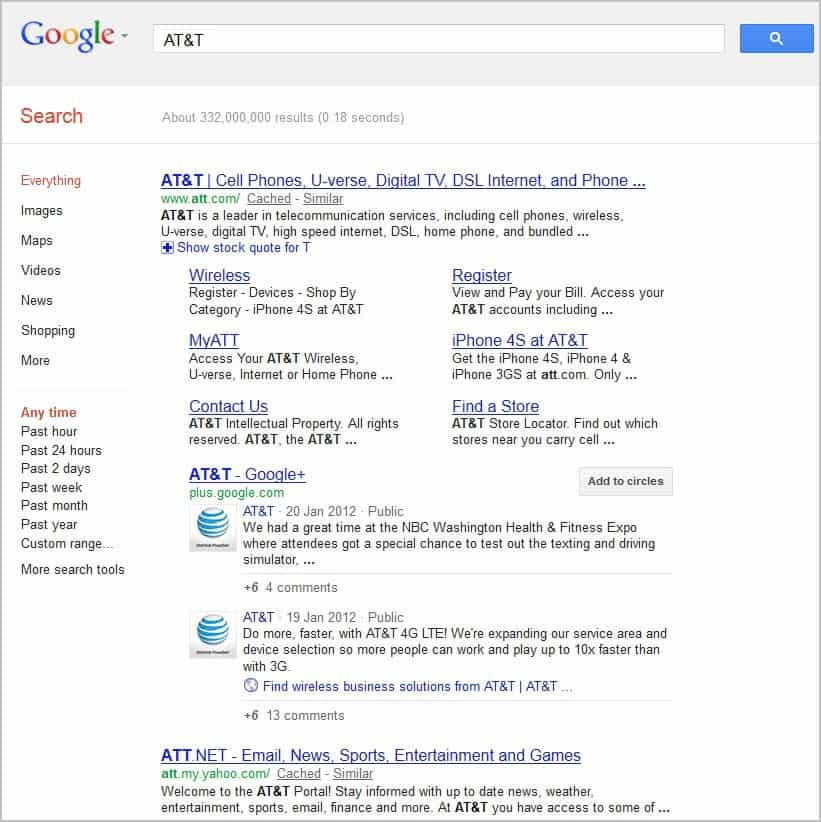
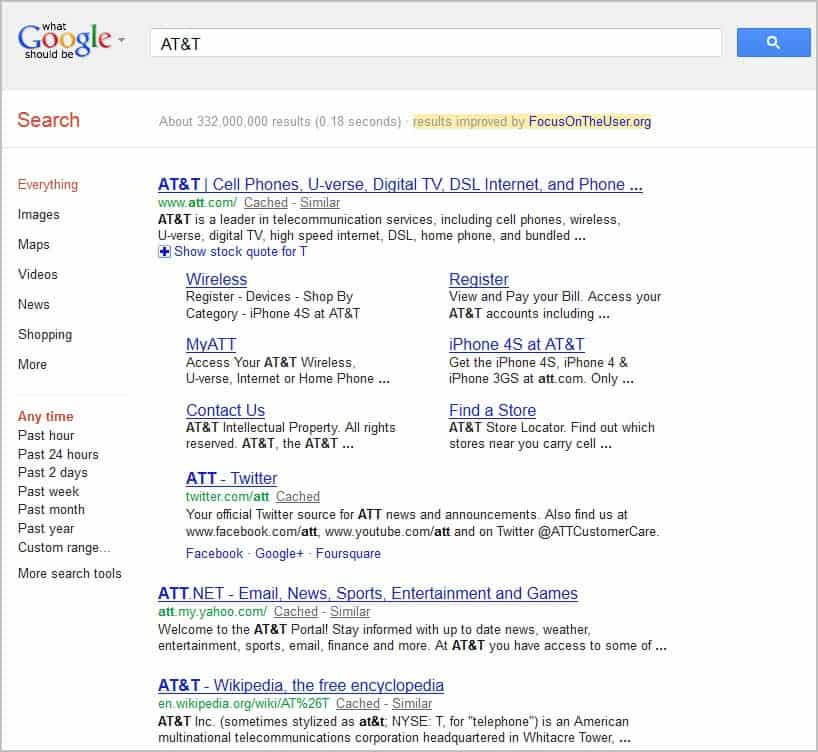
Below are two screenshots. The first is a copy of a standard search for AT&T on Google, the second how the page looks like once you have run the bookmarklet.

google search result

google dont be evil

The bookmarklet has replaced the Google+ listing with the more relevant Twitter account listing. We need to look at how relevancy is computed to make sure that it does not just favor other social networking sites over Google. According to the developers, their tool checks Google Search for the term to select the first social networking listing in the standard results as the most relevant term. Standard result means a page that Google has not hardcoded into the search results.

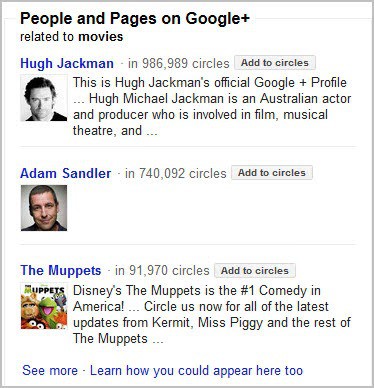
The bookmarklet will also analyze people and pages results on the right side with relevant results

people and pages

and the suggestions when you start typing a name into the search form.

suggestions

It is interesting to note that the bookmarklet enables the feature for the session, and not only for the current page that you are on. Results are automatically adjusted if you use Google Search functionality on the same page again.

Is this making the search results on Google more relevant? The answer should be yes if you look at a pool of users. When it comes down to the individual user, it depends solely on that user’s preference. Some users do not want to see social signals in the results at all, others may be using Google+ exclusively or a mixture of services. Users should not turn this into a Google vs Facebook vs Twitter vs Whatever fight. Instead, they should look at what they want their search results to be and voice that opinion loud and clear.

How they do that? By switching to another search engine for instance if they feel that Google Search has deteriorated in the past year. If users flock to other search engines, then Google may be willing to reanalyze their latest strategies and may return to impartial search results.

The developers have created a browser extension for Google Chrome that automates the process. You can download it only directly from the Focus on the user website.

Here is a video demonstration of the bookmarklet.

Keep in mind that while not officially released by Facebook or Twitter, it still has their stamp all over it. I suggest you read Giga Om’s comment on this.

What’s your take on this? Voice your opinion in the comments.


Thursday, January 19, 2012

Drag2Up Lets You Upload Files Via Drag And Drop In Chrome

If you upload files, images or text documents for instance, regularly from your computer to Internet sites, you’d probably realized that the process is everything but straightforward. This is especially true if you want to post a file on a site that does not offer uploading capabilities, a comment on a web blog for instance. What you would have to do then is the following:

  • Find an appropriate host for the file. This can be self hosted web space or a file hosting service.
  • Open the file browser, locate the file on your computer and select to upload it
  • Grab the link to the file and paste it into the comment form at the exact location that you want it to appear.

This process becomes a thing of the past with Drag2Up for the Google Chrome browser. You specify an image, text and binary hosting services from the available selection. Once you have done that, you can use any web form on the Internet to upload files to those services. Even better, the extension pastes the link to the uploaded files directly in that web form.

This is for instance ideal for users who like to post images on Twitter or other sites. Open the extension settings with a click on the Wrench Icon > Tools > Extensions, and the selection of Options next to the Drag2Up listing in the extensions manager.

drag and drop upload

Just drag and drop the file hosts that you want to use to the appropriate sections on the right. Here is the current list of supported hosts:

  • Images: Imgur, Imm.io, ImageShack, Snelhest, Flickr, Picasa, TwitrPix, Twitpic, Twitgoo, Img.ly, Posterous
  • Text: Gist.Github, Pastebin.com, Mysticpaste
  • Binary: Checmial Servers, DAFK Up, Minus, Hotfile, Dropbox, CloudApp, Box and Droplr

The selected hosts are then used as the default storage services when files are uploaded via the drag and drop operations. All you need to do from that moment on is to drag and drop files that you want to upload to forms on the selected web page. Let me give you an example on how this works on Twitter.

Visit the Twitter web page, and drag a file from your computer to the What’s Happening form there. You will notice that drop files here is displayed on every form on the page automatically.

twitter drag drop upload

The file is submitted to the selected file host, and the resulting link to the file posted directly in the Twitter form. This saves you quite a few steps.

You may want to disable the “enable marketing” option in the extension settings to avoid advertisement.

Google Chrome users can download the latest version of Drag2Up from the official Chrome Web Store.


Tuesday, January 3, 2012

My Permissions Lets You Clean App Permissions

With the popularity of a service and an api come third party services that either use the service’s authorization system or add functionality to the service. A prime example is Facebook. Sites on the Internet may allow you to log in to the service with your Facebook credentials. This is useful as users do not have to register yet another account before they can use the service. It does however mean that users need to authorize those apps to use that data.

And with multiple popular services doing this, it may quickly become a control issue. It is not that sites like Facebook or Twitter are hiding the pages where apps that have been authorized in the past are listed, but it still requires the user to know that a page for managing app permission exists.

My Permissions is a free web service that offers two core features. It first links directly to the app permission management pages on eight social networking sites. Included by the service are Facebook, Twitter, Google, Yahoo, Linkedin, Dropbox, Instragram and Flickr.

app permissions

A click on a button opens the app settings control panel of the selected service in a new tab. You may be asked to log in first before you can manage app permissions. If you are already signed in, you can edit or remove app permissions right away. It usually takes a single click to remove an application from the list of connected apps.

You can naturally bookmark the links right away to open the app permission pages right away without having to visit the My Permissions page first.

The developers have created an ifttt recipe that reminds users once per month to check app permissions on social networking sites that they use.

If you are a heavy app and social networking user you may appreciate the service. Everyone else can still use it to check which apps have been authorized currently. (via Caschy)


© Martin Brinkmann for gHacks Technology News | Latest Tech News, Software And Tutorials, 2012. | Permalink |
Add to del.icio.us, digg, facebook, reddit, twitter
Post tags: , ,


Friday, December 30, 2011

Internet Giants Consider SOPA Strike

The Stop Online Piracy Act in the US is getting ever more publicity with GoDaddy one of the high profile companies to suffer from supporting it as we wrote a couple of days ago.  In our previous article Martin summed up SOPA very effectively.

If you are living in the United States, you should have heard about SOPA (Stop Online Piracy Act) and Protect-IP, which, when passed, would give companies rights that they should not have. If it passes, IP rightsholders (a term vaguely defined) could send notices to payment processors or ad services like Google Adsense to force them to stop doing business with listed websites, all without legal process.

Site owners have five days to file a counter-notice, but neither payment processors or ad networks have any obligation to respect it. Even worse, they are granted “immunity for choking off a site if they have a “reasonable belief” that some portion of the site enables infringement”.

Now a loose confederation of Internet giants are considering shutting down the entire websites for 24 hours and instead showing a messagew urging their visitors and customers to contact their representative in the US congress the day before the vote goes to the house there.

The coalition is made up of some very big names on the Internet including Google, Amazon, Facebook, Twitter, Wikipedia, Yahoo!, eBay, PayPal, AOL, Foursquare, IAC, LinkedIn, Mozilla, OpenDNS and Zynga.  If the plan goes ahead all these services could be taken offline for 24 hours.

In a report by CNet

When the home pages of Google.com, Amazon.com, Facebook.com, and their Internet allies simultaneously turn black with anti-censorship warnings that ask users to contact politicians about a vote in the U.S. Congress the next day on SOPA, you’ll know they’re finally serious.

True, it would be the political equivalent of a nuclear option–possibly drawing retributions from the the influential politicos backing SOPA and Protect IP–but one that could nevertheless be launched in 2012.

“There have been some serious discussions about that,” says Markham Erickson, who heads the NetCoalition trade association that counts Google, Amazon.com, eBay, and Yahoo as members. “It has never happened before.”

This wouldn’t be the first piece of anti-piracy legislation around the world to face stiff opposition.  France have already passed an Internet copyright law but the Digital Economy Act in the UK stalled in the face of arguments from major Internet Service Providers British Telecom and TalkTalk.

Many reports say that SOPA is still set to pass the US congress and that very few Americans have heard about it.  Shutting down services such as Facebook and Google, and replacing them with anti-SOPA messages for a day would certainly raise awareness, but a question mark remains over whether doing so only one day before the congress vote would be effective enough.

This is the first time ever that major websites have threatened to effectively go on strike to boycott something, and it is completely unprecedented.  It is unclear at this time whether the services would be taken down worldwide or just in the US and also how serious the coalition are about the boycott, which would inevitably lose them all a day’s trade.

Services are commonly targeted for IP addresses anyway and it wouldn’t be difficult for these companies to target messages to their US-based users.  With many millions of visitors every day in the US, companies such as Google and Facebook could achieve this on their own.  Imagine then how much more leverage they would have with Amazon, Yahoo! and others on board.  If this goes ahead it is still possible that other companies could follow suit, effectively crippling the Internet in the US for the day before the vote.

So what do you think of SOPA and your favourite websites being taken offline for a day?


© Mike Halsey MVP for gHacks Technology News | Latest Tech News, Software And Tutorials, 2011. | Permalink |
Add to del.icio.us, digg, facebook, reddit, twitter
Post tags: , , , , , , , , , , , , , , ,